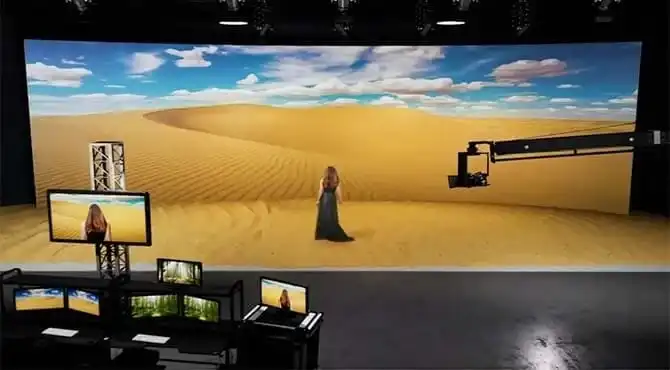
Is Your XR / Virtual Production Facing These Challenges?
| Pain Point | XR Production Reality |
|---|---|
| ☐ Scan lines on camera | Low refresh or high scan ratio causes dark bands during quick pans |
| ☐ Color mismatch with render | LED wall looks different from what Unreal Engine outputs |
| ☐ Camera tracking drift | Virtual background shifts relative to real camera movement |
| ☐ Latency breaks immersion | Delay between actor movement and background response causes nausea |
| ☐ Floor reflection issues | LED floor reflects on talent or props, breaking illusion |
| ☐ Moiré on fine details | Textured costumes or set pieces create interference patterns |
Our XR-grade LED volumes are engineered from the ground up for virtual production — eliminating every technical barrier between physical and digital worlds.
Core Advantages
Camera-Perfect XR Performance
- 7680Hz refresh rate – zero flicker, zero scan lines
- 1/8 low scan ratio – eliminates dark bands on moving cameras
- Anti-moiré coating – clean textures, no interference
Real-Time Render Compatibility
- <1 frame latency (16ms at 60fps) – imperceptible delay
- Unreal Engine native – Direct integration via Disguise / Brompton / Megapixel
- HDR10 / Rec.2020 – Match render output exactly
Floor-Ready Design
- 2000kg/m² load capacity – walk, dance, drive on it
- Anti-slip matte coating – talent safe
- Seamless flatness – ±0.5mm tolerance – no visible joints
Complete Tracking Ecosystem
- Compatible with: Mo-Sys, Stype, Trackmen, OptiTrack, Vicon
- Genlock sync – frame-accurate camera tracking
- Free-d / UDP input – standard tracking protocols
Product Recommendation Matrix – XR Volume
| Volume Zone | Recommended Model | Pitch | Key Requirement |
|---|---|---|---|
| Main LED Wall (Vertical) | P1.2 / P1.5 / P1.8 | 1.2-1.8mm | Low scan, high refresh, curved |
| LED Floor | P1.8 / P2.5 / P3.9 | 1.8-3.9mm | Load-rated, anti-slip, seamless |
| LED Ceiling (Optional) | P1.8 / P2.5 | 1.8-2.5mm | Lightweight, curved |
| Side Wings / Immersion Walls | P1.8 / P2.5 | 1.8-2.5mm | Curved, color-matched to main wall |
XR Volume Sizing Guide
| Studio Size | Recommended Volume | Wall Size (W x H) | Floor Depth | Total LED Area | Pitch |
|---|---|---|---|---|---|
| Small (10m x 5m) | Single wall + floor | 8m x 3m | 5m | 55m² | P1.8 / P2.5 |
| Medium (15m x 8m) | Curved wall + floor | 12m x 4m | 7m | 85m² | P1.5 / P1.8 |
| Large (20m x 10m) | Full volume (walls + floor + ceiling) | 16m x 5m | 10m | 150m²+ | P1.2 / P1.5 |
| Automotive / Product | Cylindrical or tunnel | Custom | Full envelope | 200m²+ | P1.2 / P1.5 |
Technical Specifications – XR Grade LED
Critical XR Parameters
| Parameter | Specification | Why It Matters for XR |
|---|---|---|
| Refresh rate | 7680Hz (minimum 3840Hz) | Eliminates scan lines on moving cameras |
| Scan ratio | 1/8 or lower (1/16 ideal) | Prevents dark band artifacts in HFR shooting |
| Grayscale | 16-bit minimum | Smooth gradients, no banding in dark scenes |
| Frame delay | <1 frame (16ms @60fps) | Real-time render sync, no motion sickness |
| Brightness (HDR) | 1500-2000nit (calibrated to 1000nit+) | Match real-world lighting, realistic reflections |
| Color gamut | Rec.2020 (minimum Rec.709) | Match Unreal Engine color space |
| Delta E | <2 | Indistinguishable from render output |
| Contrast ratio | 10,000:1 (minimum 5000:1) | Deep blacks, virtual shadows |
| Surface flatness | ±0.5mm | No visible seams between cabinets |
| Load capacity (floor) | 2000kg/m² | Support talent, props, vehicles |
| Anti-slip coating | Matte, R11 | Talent safety, reduced reflection |
LED Module – Physical (Floor Specific)
| Parameter | Wall Module | Floor Module |
|---|---|---|
| Pixel pitch | P1.2 / P1.5 / P1.8 | P1.8 / P2.5 / P3.9 |
| Load capacity | N/A | 2000kg/m² |
| Surface | Matte black (5% reflectivity) | Anti-slip matte + scratch resistant |
| Protection | IP20 | IP54 (dust + splash) |
| Thickness | 65mm | 85mm (reinforced) |
| Weight | 18kg/m² | 28kg/m² |
| Cabinet size | 500x500mm / 600×337.5mm | 500x500mm (reinforced frame) |
| Seam tolerance | ±0.2mm | ±0.5mm (floor to wall) |
Processing & Sync
| Parameter | Specification |
|---|---|
| Processor compatibility | Brompton Tessera, Megapixel Helios, Novastar H-series |
| Input | 12G-SDI, DisplayPort 1.4, Fiber |
| Genlock | Black Burst / Tri-level sync |
| Camera tracking protocols | Free-d, UDP, Stype, Mo-Sys, Trackmen |
| Render engine sync | Unreal Engine nDisplay, Disguise, Pixotope |
XR Virtual Production Ecosystem Integration
Render Engines (Native Support)
| Engine | Integration | Latency |
|---|---|---|
| Unreal Engine 5+ | nDisplay, Direct LED output | <1 frame |
| Unity | Via Disguise or Pixotope | <1 frame |
| Notch | Direct DMX / Art-Net | <1 frame |
Camera Tracking Systems (Compatible)
| Tracking System | Protocol | Genlock | Typical Accuracy |
|---|---|---|---|
| Mo-Sys Star Tracker | Free-d over UDP | ✅ | ±0.5mm |
| Stype Red Spy | Free-d / Stype protocol | ✅ | ±0.3mm |
| Trackmen | Trackmen protocol | ✅ | ±0.5mm |
| OptiTrack (Mocap) | VRPN / NatNet | ✅ | ±0.2mm |
| Vicon (Mocap) | Vicon DataStream | ✅ | ±0.2mm |
| Antycip / Vioso | Free-d | ✅ | ±1.0mm |
Media Servers (Certified)
| Server | Max Outputs | Unreal Support | LED Processor Integration |
|---|---|---|---|
| Disguise (d3 / VX) | 16x 4K | ✅ Native | Brompton, Megapixel |
| Pixotope | 8x 4K | ✅ Native | Brompton, Novastar |
| Brainstorm | 4x 4K | ✅ | Brompton |
| Zero Density | 8x 4K | ✅ | Brompton |
LED Processors (XR Optimized)
| Processor | Max Resolution | Genlock | Frame Delay | Scan Ratio Control |
|---|---|---|---|---|
| Brompton Tessera SX40 | 4K@60fps | ✅ | <0.5 frame | ✅ Full control |
| Megapixel Helios | 8K@60fps | ✅ | <0.5 frame | ✅ Full control |
| Novastar H-series | 4K@60fps | ✅ (select models) | <1 frame | ✅ Limited |
Solutions by XR Production Scenario
Virtual Production for Film / Episodic
- Challenge: Camera moves freely, need realistic lighting interaction on talent
- Solution: Full LED volume (wall + floor + ceiling) + HDR brightness (1500nit+) + camera tracking
- Result: Actors see real-time virtual environment, lighting bounces correctly, no green screen spill
Typical Configuration:
- Wall: 12m x 4m curved P1.2/P1.5
- Floor: 8m depth P1.8/P2.5 load-rated
- Ceiling: Optional P1.8
- Processing: Brompton Tessera + Disguise
Commercial / Automotive Production
- Challenge: Reflective car surfaces need realistic environment mapping
- Solution: High brightness (2000nit), wide color gamut (Rec.2020), cylindrical or tunnel volume
- Result: Car reflections match virtual background perfectly – no post-production compositing
Typical Configuration:
- Volume: Cylindrical (270° to 360°)
- Wall: P1.2/P1.5
- Floor: P1.8 (high load for vehicles)
- Processing: Megapixel Helios + Unreal nDisplay
Live Broadcast XR (News, Sports, Awards)
- Challenge: Quick setup, multiple camera angles, real-time graphics changes
- Solution: Single curved wall + floor extension + fast render engine (Disguise/Pixotope)
- Result: Talent walks through virtual worlds, graphics update live
Typical Configuration:
- Wall: 10m x 4m curved P1.5
- Floor: 4m depth P2.5
- Processing: Novastar H-series + Pixotope
Virtual Events / Metaverse Concerts
- Challenge: Remote audiences, social interaction, virtual cameras
- Solution: Medium volume + green screen hybrid + real-time stream output
- Result: Live performer interacts with virtual audience members
Typical Configuration:
- Wall: 8m x 3m P1.8
- Floor: 5m depth P2.5
- Processing: Brompton + Disguise + streaming encoder
Corporate XR Studio (In-House Production)
- Challenge: Smaller budget, easy operation, multiple content types
- Solution: Fixed volume P1.5 or P1.8 + pre-built templates + simplified tracking
- Result: Marketing team produces high-end virtual content without film crew
Typical Configuration:
- Wall: 6m x 2.5m flat or slight curve P1.8
- Floor: 3m depth P2.5
- Processing: Novastar + off-the-shelf tracking (Mo-Sys Lite)
Results / Case Study
Case: Hollywood Virtual Production Studio – Full LED Volume
| Metric | Before (Green Screen) | After (LED Volume) | Improvement |
|---|---|---|---|
| Post-production VFX time | 3 weeks | 3 days | -86% |
| Actor performance (immersion rating) | 6/10 | 9.5/10 | +58% |
| Lighting rework shots | 45% of scenes | <5% | -89% |
| Per-scene production cost | $45,000 | $18,000 | -60% |
Quote from Virtual Production Supervisor:
“Green screen always meant guessing where the background would be. With the LED volume, actors see exactly what they’re reacting to. Performance improved instantly. And the lighting interaction is physically real – no more fake reflections in post.”
Case: Automotive Brand – 360° LED Tunnel for Commercial
| Metric | Result |
|---|---|
| Volume size | 20m diameter cylinder, 5m height |
| LED area | 350m² (P1.2 walls + P1.8 floor) |
| Shoot duration | 2 days (vs 7 days on location) |
| Location costs saved | $280,000 |
| Final output | 4K HDR commercial, broadcast ready |
Quote from Director of Photography:
“Shooting a car in a studio with LED volume is a cheat code. The reflections on the paint are exactly what you want – no compositing needed. We drove the car onto the volume, lit it once, and rolled. 2 days later, we had a finished spot.”
Case: European Broadcaster – XR News Studio
| Metric | Before | After |
|---|---|---|
| Set change time between segments | 20 minutes | 10 seconds |
| Graphics integration cost (per show) | $5,000 | $200 |
| Viewer engagement (social mentions) | Baseline | +340% |
See more complete case studies in our [Case Studies Section] → View All Cases
Why XR / Virtual Production Professionals Choose Us
| Factor | What We Deliver |
|---|---|
| Low scan ratio | 1/8 or better – no dark bands on moving cameras |
| Ultra-low latency | <1 frame – real-time render sync |
| Camera tracking ready | Genlock, Free-d, all major systems |
| Floor engineering | 2000kg/m² load, anti-slip, seamless flatness |
| Color science | Rec.2020, HDR10, Delta E <2 |
| Processor choice | Brompton, Megapixel, Novastar – any brand |
| Integration support | Unreal nDisplay, Disguise, Pixotope engineers |
| Calibration | On-site calibration with your render engine |
Service Process (5-Step Conversion Path)
| Step | Action |
|---|---|
| 1. Needs Consultation | Submit venue dimensions, event type(s), and budget range |
| 2. Free On-Site Assessment | Engineers conduct on-site measurements of brightness, viewing angles, and structural load capacity |
| 3. Solution Design | Provide installation drawings, structural calculation reports, and detailed quotation |
| 4. Production / Rental | Fixed installation: 25-day delivery • Rental: 3-day preparation |
| 5. Delivery & Support | Engineer-guided on-site installation + operation training + 24/7 after-sales support |
Client Testimonials
“We toured five different LED vendors before choosing this one. The deciding factor was the scan ratio – 1/8 on their P1.2 wall. That’s what eliminates the dark bands when cameras move fast. Our first shoot with whip pans and dolly moves – zero artifacts. Our DP was speechless.”
— Virtual Production Director, Major Film Studio
“The floor is the hardest part of any XR volume. It has to be perfectly flat, take a beating, not reflect, and match the wall color exactly. Their floor modules are incredible – seams are invisible at 2 meters, anti-slip works with dance moves, and we’ve driven cars on it without a scratch.”
— Technical Director, Automotive XR Studio
“Integration with Unreal nDisplay was seamless. Their engineer stayed with us for 3 days, helped calibrate our tracking system, and validated latency frame by frame. By day 2, we were shooting. By day 3, client approved. That kind of support is rare.”
— Head of Production, Virtual Event Agency
“We built a 200m² full volume (walls, floor, ceiling). The team handled everything – structural engineering, power distribution, genlock sync with our Mo-Sys tracking. Our first virtual production shoot saved us $150,000 compared to location shooting. The volume paid for itself in 4 months.”
— Studio Owner, XR Rental Facility
FAQ
Q: What is scan ratio and why does it matter for XR?
A: Scan ratio is the percentage of LEDs lit at any moment. High scan (1/1, 1/2, 1/4) can create dark bands when cameras move quickly. XR requires 1/8 or lower (1/16 ideal) to eliminate these bands. Our panels are 1/8 standard, 1/16 available.
Q: What’s the difference between refresh rate and scan ratio?
A: Refresh rate (Hz) affects flicker visibility. Scan ratio affects motion artifacts (banding). XR needs BOTH high refresh (3840Hz+) AND low scan (1/8-). Most vendors only specify refresh. We specify both.
Q: Can the floor handle heavy equipment or vehicles?
A: Yes. Floor modules are rated at 2000kg/m² (static load). Cars, forklifts, camera dollies, and standing talent are all safe. We provide load certification for venue approval.
Q: How do you prevent seams between floor and wall?
A: Three methods: 1) Precision leveling (±0.5mm flatness), 2) Matched pixel pitch (wall and floor same pitch if possible), 3) Post-process calibration blending. Seams become invisible beyond 2 meters.
Q: What latency can I expect from render to LED?
A: <1 frame (16ms at 60fps) from render engine output to LED emission. This includes LED processing time. Imperceptible to actors and cameras.
Q: Can I use my existing tracking system?
A: Yes. We support Mo-Sys, Stype, Trackmen, OptiTrack, Vicon, and any system that outputs Free-d or UDP position data. Genlock sync ensures frame accuracy.
Q: Which LED processor should I choose?
A: Brompton (best color, most XR features), Megapixel (highest resolution, 8K+), Novastar (budget-friendly, good for broadcast). We supply any brand you prefer.
Q: How much does an XR volume cost?
A: Varies significantly by size, pitch, and processor. Typical range: Small volume (50m²) $80,000-150,000, Medium volume (100m²) $150,000-300,000, Large volume (200m²+) $300,000-800,000+. Free consultation with detailed quote.
Q: How long does installation take?
A: Small volume (wall + floor): 5-7 days. Medium volume (curved walls + floor): 10-14 days. Large volume (full enclosure): 3-4 weeks. All work scheduled around your studio availability.
Q: Do you offer rental XR volumes?
A: Yes. We have rental volumes available in major production hubs (Los Angeles, London, Shanghai, Tokyo, Dubai). Daily/weekly rates. On-site engineers included.