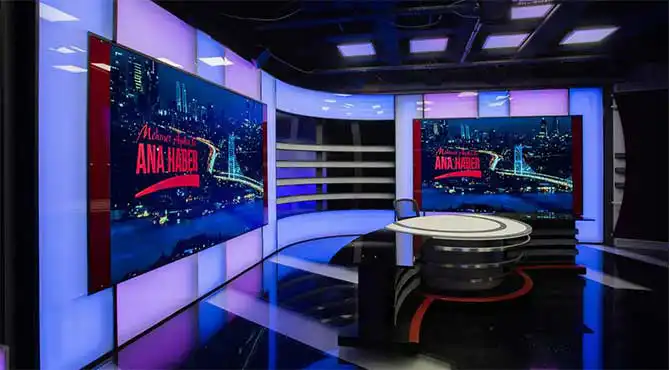
Is Your TV Studio Facing These Broadcast Challenges?
| Pain Point | Broadcast Reality |
|---|---|
| ☐ Flicker on camera | Slow-motion replays and 4K close-ups reveal distracting flicker |
| ☐ Moiré patterns | Fine clothing patterns or camera angles create ugly interference artifacts |
| ☐ Color mismatch | LED wall looks different from studio monitors and broadcast feed |
| ☐ Fan noise | Microphones pick up display cooling fans during quiet interviews |
| ☐ Low-brightness banding | Dimmed LED loses grayscale – faces look blocky in dark scenes |
| ☐ Slow content switching | Manual input changes cause awkward dead air between segments |
Our broadcast-engineered LED walls eliminate every camera-facing artifact — designed by studio engineers, for studio engineers.
Core Advantages
Camera-Perfect Performance
- 7680Hz refresh rate – zero flicker at any shutter speed / frame rate
- Anti-moiré coating + optimized pixel structure – no interference patterns
- 16-bit grayscale – smooth gradients even at low brightness (100-300nit)
Broadcast Color Science
- Rec.709 calibration (optional BT.2020 for HDR)
- Delta E < 2 – matches studio reference monitors
- 3D LUT import – match any camera’s color space
- Color temperature adjustable 3200K-6500K
Studio-Ready Physical Design
- Fanless operation – 0dB at 1 meter
- Ultra-thin (35mm) – maximises studio floor space
- Curved and custom shapes – immersive set designs
- Front service – no rear access needed
Broadcast Workflow Integration
- 12G-SDI input (BNC) – direct from vision mixer
- Genlock sync – frame-accurate with studio reference
- Low latency – <1 frame delay
- Dashboard control – recall looks per segment
Product Selection Recommendation
| Studio Type | Recommended Model | Pitch | Screen Size | Key Requirement |
|---|---|---|---|---|
| News Studio (Anchor Background) | P1.2 / P1.5 | 1.2-1.5mm | 6m – 15m wide | Moiré-free, skin tone accuracy |
| Talk Show / Interview | P1.5 / P1.8 | 1.5-1.8mm | 4m – 10m wide | Silent, low-brightness grayscale |
| Weather Segment (Green Screen hybrid) | P1.2 / P1.5 | 1.2-1.5mm | 4m – 8m wide | Seamless with chroma key |
| Virtual Production Studio (XR/VP) | P0.9 / P1.2 | 0.9-1.2mm | 10m – 30m wide | High refresh, low scan, curved |
| Control Room / Monitoring Wall | P1.2 | 1.2mm | Custom | Multi-window, SDI inputs |
| Audience / Backdrop Displays | P1.8 / P2.5 | 1.8-2.5mm | Large format | Cost-effective, reliable |
Technical Specifications for Broadcast Engineers
Broadcast LED Wall – Core Parameters
| Parameter | Specification | Broadcast Requirement |
|---|---|---|
| Refresh rate | 7680Hz (standard) | >3840Hz for 60fps, >7680Hz for 120fps slow-mo |
| Scan ratio | 1/8 to 1/16 | Lower scan = better camera performance |
| Grayscale | 16-bit (65536 levels) | Smooth gradients, no banding |
| Brightness (calibrated) | 100-1500nit adjustable | News: 200-400nit, HDR: 1000nit+ |
| Color gamut | Rec.709 (standard) / BT.2020 (HDR) | Match broadcast color space |
| Delta E (color accuracy) | <2 | Indistinguishable from reference |
| Frame delay | <1 frame (16ms at 60fps) | Lip-sync accurate |
| Inputs | 12G-SDI, HDMI 2.0, DP, Fiber | Direct from vision mixer |
| Sync | Genlock (Black Burst / Tri-level) | Frame-accurate with studio |
| Refresh / calibration | Built-in colorimeter port | Automated daily calibration |
| Noise level | 0dB (fanless) | Safe for live mics |
| Operating temperature | 0-40°C | Standard studio environment |
LED Module – Physical Specifications
| Parameter | Value |
|---|---|
| Cabinet size | 600×337.5mm or custom |
| Thickness | 35mm (wall mount) / 65mm (rigid frame) |
| Weight | 16kg/m² |
| Front service | Yes – magnetic modules, tool-less |
| Curvature | ±10° (concave/convex) |
| Ingress protection | IP20 (indoor) |
Broadcast Integration Ecosystem
Input Compatibility
| Signal Type | Supported | Max Resolution | Notes |
|---|---|---|---|
| 12G-SDI (BNC) | ✅ | 4K@60fps | Direct from vision mixer |
| 3G-SDI | ✅ | 1080p@60fps | Legacy studios |
| HDMI 2.0 | ✅ | 4K@60fps | Presentation inputs |
| DisplayPort 1.2 | ✅ | 4K@60fps | PC sources |
| Fiber Optic | ✅ | 8K@60fps | Long distance (>100m) |
| NDI | ✅ | 4K@60fps | IP workflow |
Sync & Timing
- Genlock input: Black Burst (analog) or Tri-level (HD)
- Phase adjustment: ±1 frame, 1-line increments
- Multiple wall sync: Single master genlock for video walls across studio
Control Protocols
| Protocol | Use Case |
|---|---|
| RS232 / RS485 | Legacy studio automation |
| TCP/IP (Ethernet) | Dashboard control, remote management |
| Art-Net / sACN | DMX integration with lighting console |
| MIDI | Live show cueing |
| Ross / Grass Valley | Production switcher integration |
Solutions by TV Studio Scenario
News Studio – Anchor Background Wall
- Challenge: Moiré patterns on anchor’s suit + flicker during slow-motion replays
- Solution: P1.2 LED wall + anti-moiré coating + 7680Hz refresh + 3200K color temp (tungsten match)
- Result: Clean camera feed, accurate skin tones, zero artifacts
Typical Configuration:
- Size: 8m wide x 3m high (curved or flat)
- Pitch: P1.2 or P1.5
- Brightness: 300-400nit (studio lighting conditions)
- Mount: Fixed wall, front service
Talk Show / Interview – Living Room Set
- Challenge: Fan noise from displays gets picked up by boom mics
- Solution: Fanless LED modules + low-brightness high-grayscale (200nit)
- Result: Clean audio track, comfortable viewing for on-camera talent
Typical Configuration:
- Size: 6m wide x 2.5m high (often segmented into “windows”)
- Pitch: P1.5 or P1.8
- Brightness: 150-250nit
- Mount: Studio scenic frame
Weather Segment – Hybrid Chroma Key + LED
- Challenge: LED wall reflections on green screen, color spill
- Solution: Matte surface LED + precise color calibration (match keyer)
- Result: Clean key, meteorologist interacts with both LED and virtual graphics
Typical Configuration:
- Size: 5m wide x 3m high
- Pitch: P1.2 or P1.5
- Brightness: 300nit
- Special: Non-reflective coating
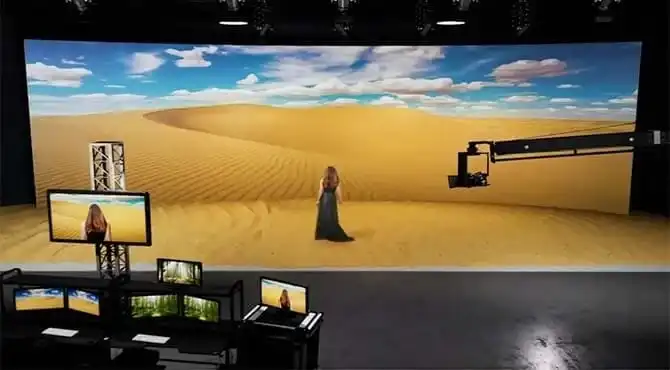
Virtual Production / XR Studio – LED Volume
- Challenge: Camera tracking, low scan ratio, curved seamless walls
- Solution: P0.9 or P1.2 LED volume (walls + ceiling) + camera tracking markers + genlock sync
- Result: Real-time rendered backgrounds with correct perspective
Typical Configuration:
- Size: 15-30m wide x 5m high + LED ceiling
- Pitch: P0.9 (lead wall) / P1.8 (side/ceiling)
- Brightness: 1000nit+ (to match lighting)
- Special: Low scan ratio (1/8 or better), curved cabinets
Control Room – Multi-Window Monitoring
- Challenge: Operators need to view multiple SDI feeds simultaneously
- Solution: Fine-pitch LED wall with multiviewer processor
- Result: Replace 12x monitors with single seamless wall
Typical Configuration:
- Size: 6m x 1.5m (ultra-wide aspect)
- Pitch: P1.2
- Inputs: 8x 3G-SDI
- Processor: Built-in multiviewer (4/8/16 windows)
Results / Case Study Section
Case: National News Network – Flagship Evening News Studio
| Metric | Before (LCD Video Wall) | After (LED Wall) | Improvement |
|---|---|---|---|
| Moiré complaints (camera dept) | Weekly | 0 in 18 months | -100% |
| Color matching time (daily) | 45 minutes | 5 minutes | -89% |
| Fan noise in audio track | Audible (-65dB) | Inaudible (-85dB) | -20dB |
| Studio setup time (new segments) | 2 hours | 15 minutes | -87% |
Quote from Director of Engineering:
“Our camera operators used to dread any shot tighter than a medium close-up – the moiré on suits was impossible to eliminate. This LED wall solved it completely. And the color calibration matches our studio monitors perfectly. Finally, what the director sees on the wall matches what goes to air.”
Case: Major Market News Station – Morning Show Upgrade
| Metric | Result |
|---|---|
| Studio downtime during installation | 0 (weekend install, aired Monday) |
| Audience feedback (visual quality) | +42% positive mentions |
| Segment transition time | 45 sec → 8 sec |
| 18-month service calls | 0 |
Quote from Technical Operations Manager:
“We installed over a weekend and aired Monday morning without a single hitch. The 12G-SDI input meant no extra converters – straight from our vision mixer to the wall. Our morning show looks like primetime now.”
See more complete case studies in our [Case Studies Section] → View All Cases
Why Broadcast Engineers Choose Us
| Factor | What We Deliver |
|---|---|
| Camera performance | 7680Hz refresh + anti-moiré + low scan ratio |
| Color accuracy | Rec.709 calibrated, Delta E <2, 3D LUT support |
| Audio safe | 0dB fanless – clean microphone tracks |
| Broadcast inputs | 12G-SDI native, genlock, <1 frame delay |
| Reliability | Redundant power/signal, 100,000 hour lifespan |
| Serviceability | Front service, modules swapped in 30 seconds |
| Support | 24/7 broadcast hotline, spares within 4 hours |
| Compliance | EBU R95, SMPTE standards |
Service Process (5-Step Conversion Path)
| Step | Action |
|---|---|
| 1. Needs Consultation | Submit venue dimensions, event type(s), and budget range |
| 2. Free On-Site Assessment | Engineers conduct on-site measurements of brightness, viewing angles, and structural load capacity |
| 3. Solution Design | Provide installation drawings, structural calculation reports, and detailed quotation |
| 4. Production / Rental | Fixed installation: 25-day delivery • Rental: 3-day preparation |
| 5. Delivery & Support | Engineer-guided on-site installation + operation training + 24/7 after-sales support |
Client Testimonials
“The moiré on patterned suits was the bane of our news director’s existence. We tried everything – different cameras, different lenses, different angles. The only thing that fixed it was this LED wall. The anti-moiré coating is magic. Two years, zero complaints.”
— Chief Engineer, Network Affiliate Station
“We do live music performances in our studio. The fan noise from our old displays was always a battle – we’d have to mic around it. These LED walls are completely silent. Our audio team cried tears of joy.”
— Technical Director, Live Broadcast Studio
“Virtual production changed everything for us. The P0.9 LED volume with camera tracking lets us shoot scenes that would cost $500k on location. And the genlock sync means zero tearing when cameras whip pan. It just works.”
— VP of Production, Streaming Network
“Installation over a weekend, aired Monday morning. No test patterns, no calibration emergencies, no last-minute engineering headaches. That never happens in broadcast. This team understands how TV works.”
— Operations Manager, Local TV Station
FAQ
Q: Will I see flicker on slow-motion cameras (120fps+)?
A: No. Our 7680Hz refresh rate is 4x the broadcast minimum (1920Hz). Tested and validated at 240fps slow-mo with no visible flicker. Test report available upon request.
Q: What causes moiré and how do you prevent it?
A: Moiré occurs when the camera’s pixel grid interferes with the LED’s pixel structure. We use three methods: 1) Anti-moiré optical coating on LED face, 2) Optimized pixel layout (non-standard grid), 3) Recommended camera distance/focal length charts. Combined, moiré is eliminated.
Q: Can the wall match our existing studio monitors?
A: Yes. We calibrate to Rec.709 (standard HD) or BT.2020 (HDR). Delta E <2 means the LED wall is visually indistinguishable from your reference monitors. We can also import 3D LUTs to match any specific camera.
Q: Is the wall silent enough for interviews?
A: Yes. Fanless design – 0dB at 1 meter. In a typical studio noise floor of -68dB, the LED wall is completely inaudible. We can provide acoustic measurement reports.
Q: Can I input SDI directly?
A: Yes. Native 12G-SDI input (BNC). No external converters needed. Supports 4K@60fps, 1080p@60fps, and all standard broadcast formats.
Q: What about genlock?
A: Standard feature. Black Burst or Tri-level sync input. Phase adjustable from -1 to +1 frame in line increments. Multiple walls can be genlocked to the same reference.
Q: How fast is the content switching?
A: Sub-second via dashboard recall. Pre-program “looks” for each segment (news, weather, sports). Switching between sources is seamless – no black frames.
Q: What happens if a module fails during a live broadcast?
A: Redundant power and signal paths mean no single module failure affects the image. If a module has dead pixels, front-service replacement takes 30 seconds – but we recommend replacing between segments, not live.
Q: How do you handle daily calibration?
A: Optional built-in colorimeter port. Connect a probe, run automated calibration routine (5 minutes). Or our remote team can calibrate via network.
Q: What is the lifespan for 24/7 broadcast use?
A: 100,000 hours to half brightness – approximately 11 years of continuous operation. Most stations refresh studio sets every 5-7 years.
Q: Can this be used for virtual production (XR/VP)?
A: Yes. We provide P0.9 and P1.2 LED volumes with camera tracking integration (MOSART, Stype, or custom). Low scan ratio (1/8) and high refresh (7680Hz) are essential for VP – both standard in our broadcast line.